Summary: A bespoke bookcase is built to the exact dimensions of a wall or alcove, with adjustable shelves suited to the client's book formats and objects. It can be made in solid wood, veneered board, or lacquered MDF depending on budget and desired finish, and is installed in the Romandy region of Switzerland within six to twelve weeks depending on project complexity.
In a living room in Coppet, a bookcase bought from a large furniture retailer leaves a fourteen-centimetre gap below the ceiling and two centimetres on each side: three days after delivery, the client calls back looking for a solution. That is often how a bespoke project begins — not out of whim, but because the dimensions of a real room never match those of a standard range.
A bespoke bookcase responds precisely to the ceiling height, the available width, the type of books being stored, and the intended use of the piece. This guide details the decisions to be made — timber species, structure, thicknesses, shelves, doors, lighting — so that a project takes shape without unwelcome surprises.
Why a bespoke bookcase differs from an off-the-shelf piece
The most obvious difference is dimensional: a wall 387 cm wide and 268 cm tall appears in no catalogue. But bespoke goes further. Shelves are calculated according to the actual book formats: a large illustrated volume needs at least 33 cm of clear height, a paperback novel needs 22 cm, and mixing the two on the same shelf is possible if repositionable shelf pins are planned from the outset.
Load-bearing capacity is another parameter. A 240 cm-wide bookcase with 19 mm melamine shelves will visibly sag under the weight of hardbound books. In our workshop, we move to 25 mm thickness — or even 30 mm in solid wood — as soon as the span exceeds 90 cm between two intermediate uprights. This deflection calculation applies even to decorative shelves: a shelf that dips in the middle, even by a few millimetres, quickly becomes noticeable.
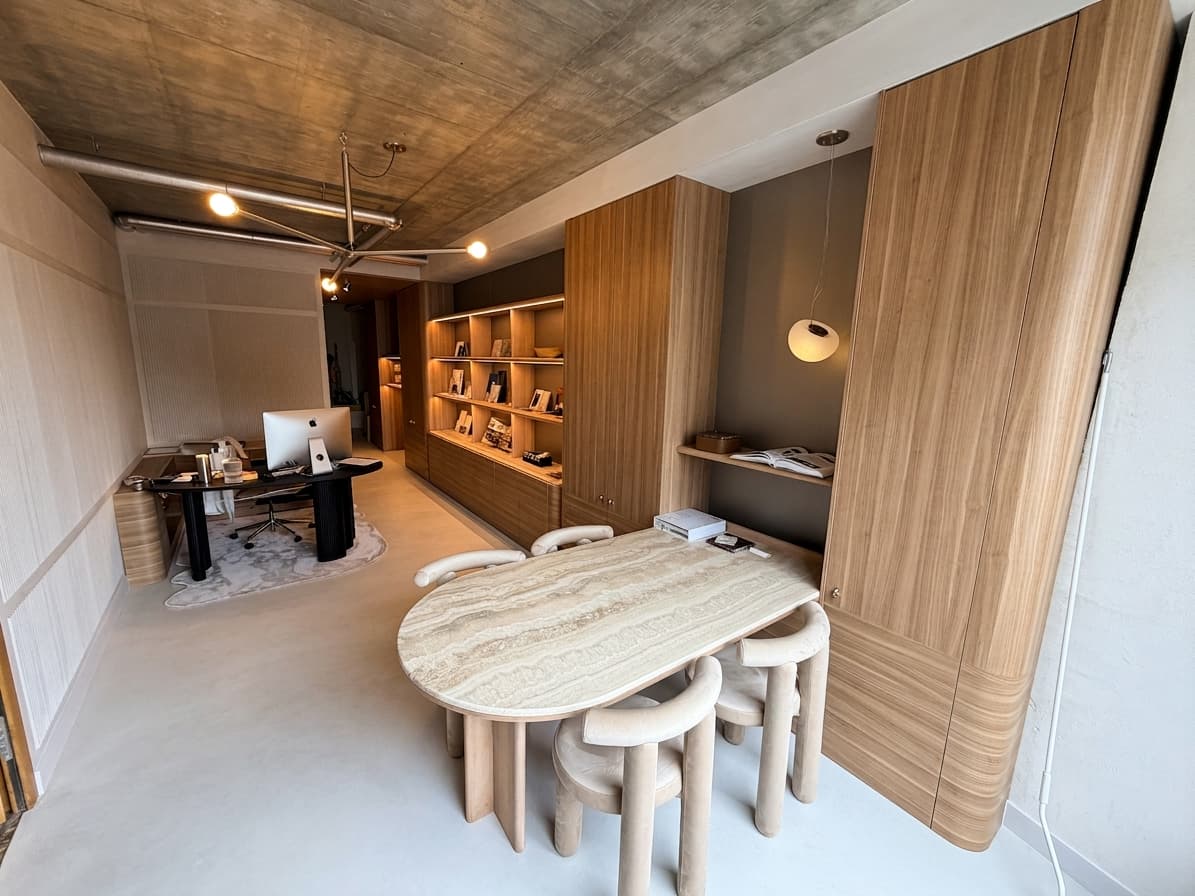
Finally, there is architectural integration: a bespoke bookcase can run from floor to ceiling, route around a socket, interface with an existing cornice, dress a recess beneath a staircase, or occupy the full depth of an alcove. It is this adaptation to the real constraints of a given space that justifies the investment.
Choosing the structure: solid wood, veneer, or melamine
All three materials are used in our workshop, often in combination. Here is what each one offers in practice.
Solid wood
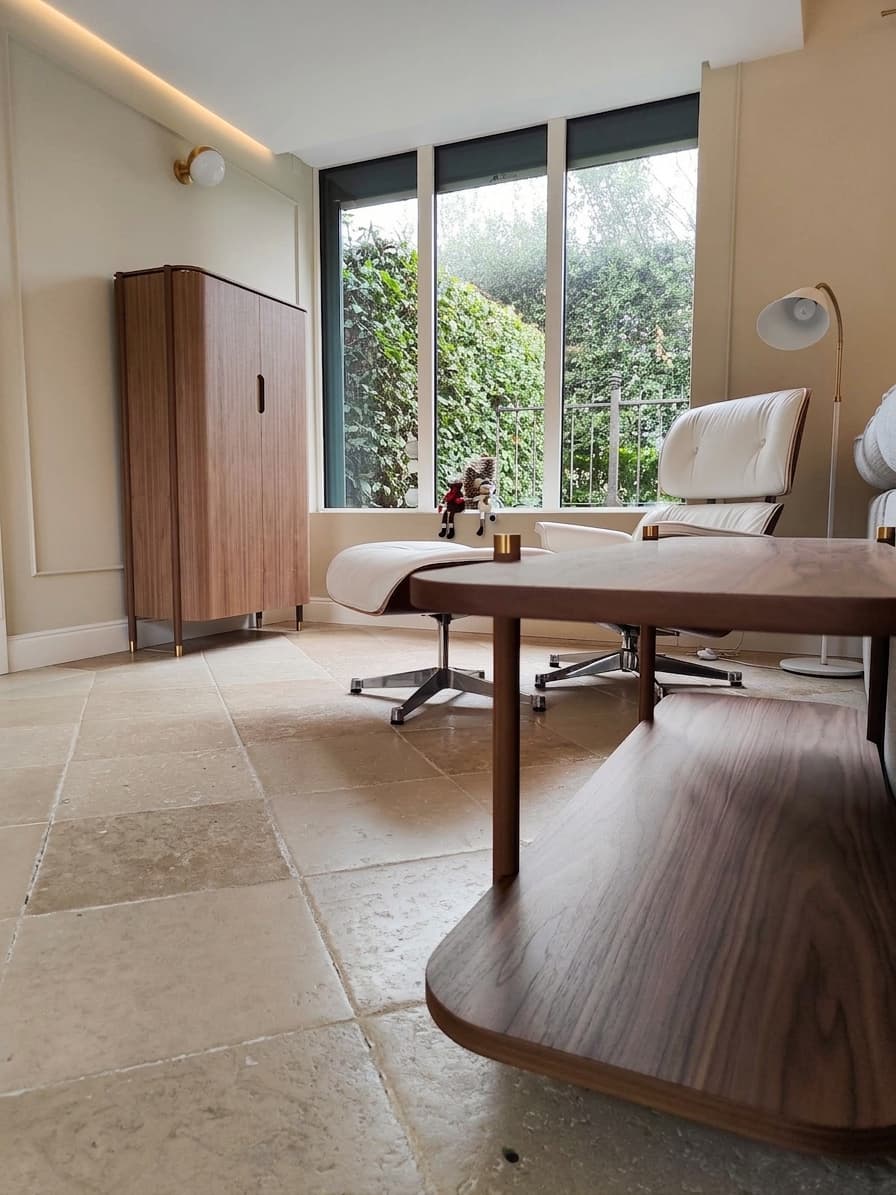
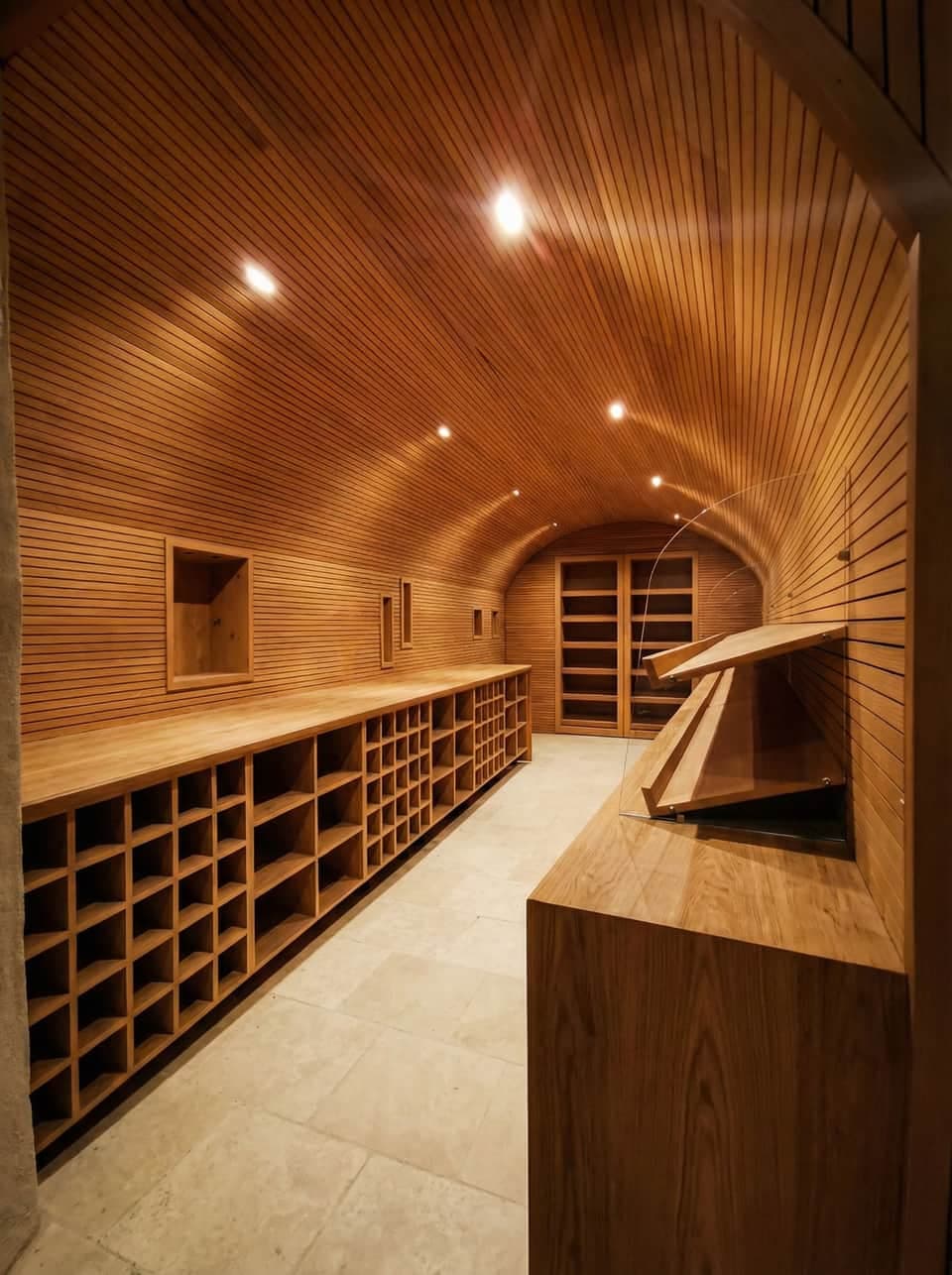
European oak is the most requested timber for bookcases in Romandy: good hardness, regular grain, availability in useful lengths. American walnut offers a warmer look, more pronounced figuring, and a naturally dark tone that often makes staining unnecessary. Ash and maple are lighter and suit contemporary interiors. In solid wood, shelves move slightly with the seasons; we allow for expansion grooves on large surfaces and avoid cross-grain gluing on breadboards. Discover why American walnut is a timber in a class of its own if you are considering a characterful bookcase.
Veneered board
An MDF or plywood panel faced with a 0.6 to 1.5 mm veneer gives the appearance of solid wood with superior dimensional stability. This is the option we recommend for large flat surfaces — back panels, wide shelves, side panels — as veneer does not crack when humidity varies. Assembly is still visible at the edges: these are covered with a solid-wood lipping to ensure a consistent finish.
Melamine and lacquered MDF
For a contemporary bookcase lacquered in white, grey, or a custom RAL colour, MDF spray-lacquered in a finishing booth is the most coherent choice. The surface is perfectly flat, with no grain or pores, giving a flawless matt or satin finish. Melamine, for its part, suits functional bookcases or workspaces where value for money takes precedence over a premium finish.
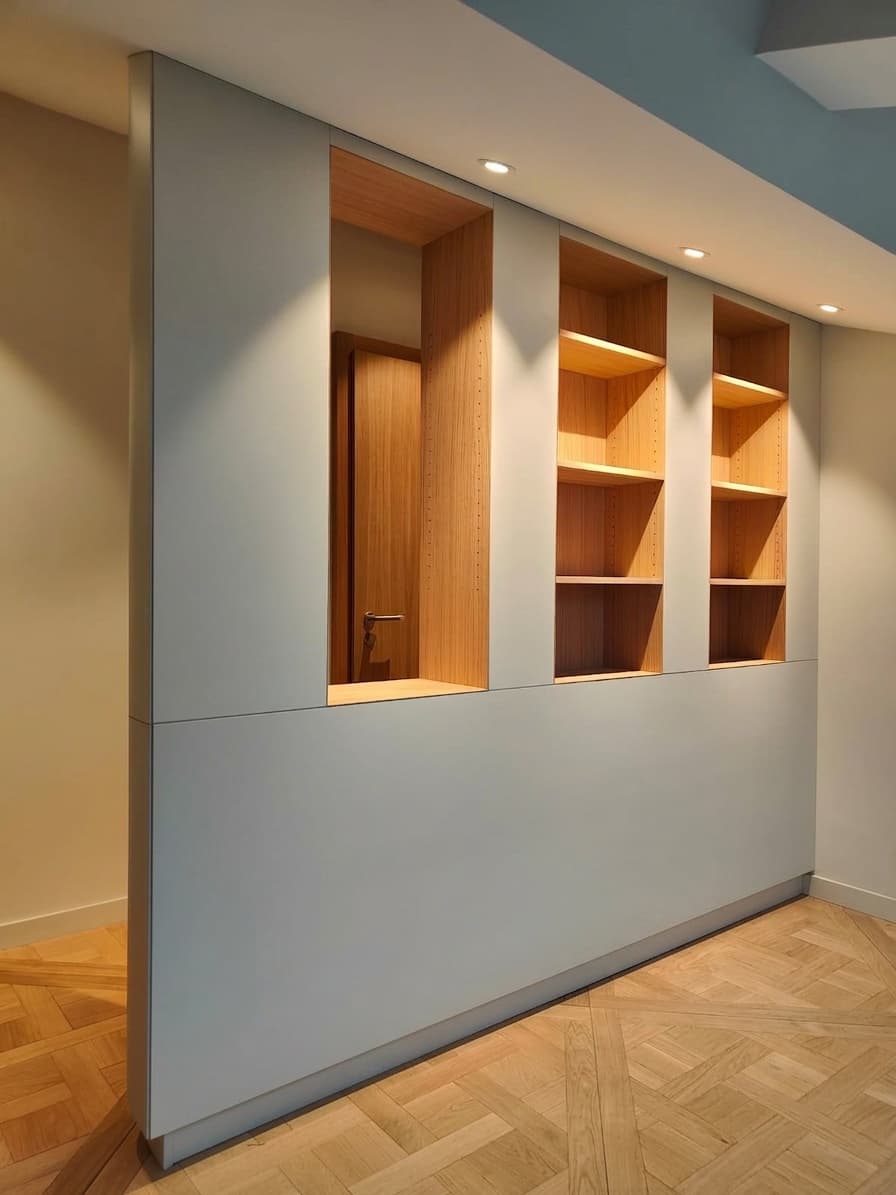
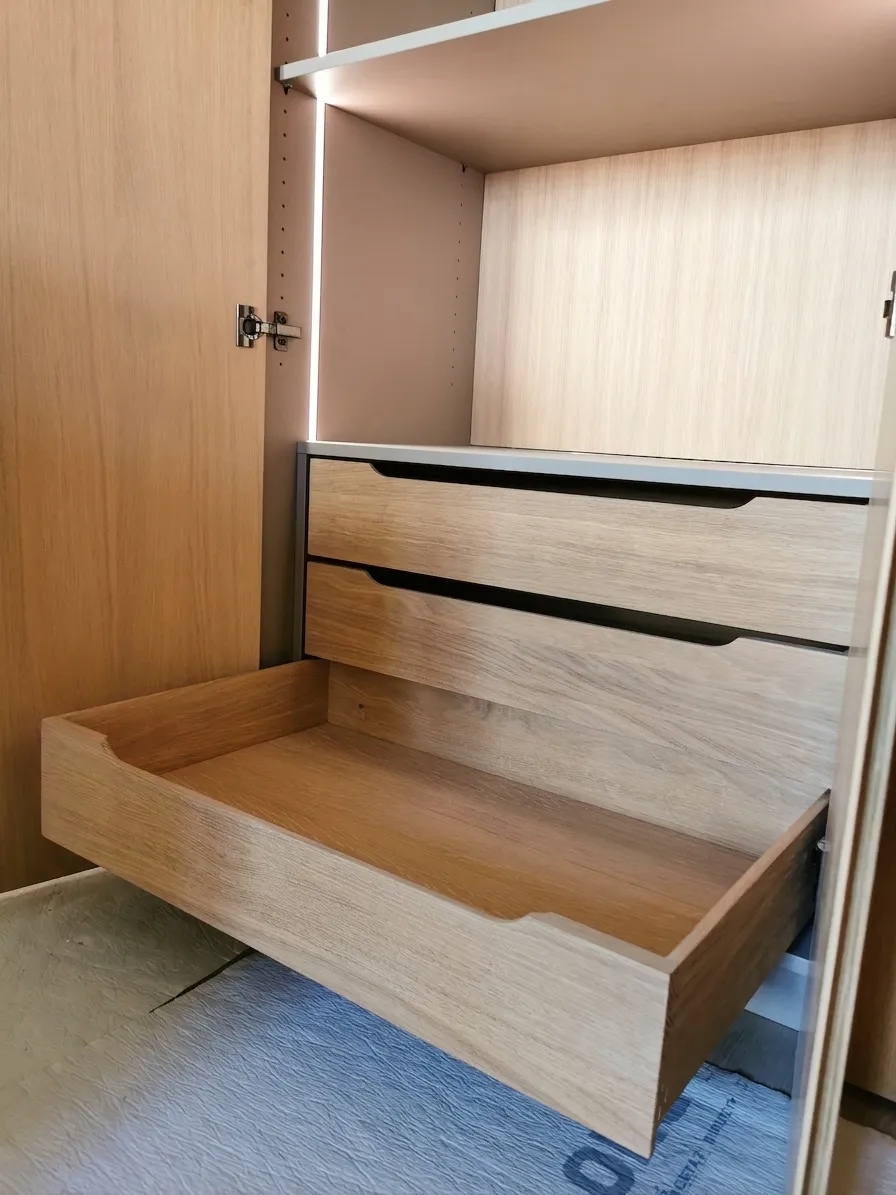 real project photo
Dimensions and thicknesses: the measurements to keep in mind
Thicknesses are not a trivial matter. Here are the values we apply systematically:
- Shelves spanning up to 80 cm: 22 to 25 mm is sufficient in thick melamine or veneered MDF.
- Shelves spanning 80 to 100 cm: 28 to 30 mm in solid wood, or a flat steel reinforcement bar embedded within the shelf thickness.
- Shelves spanning more than 100 cm: an intermediate upright is mandatory, or a welded metal reinforcement, regardless of timber species.
- Standard depth: 28 to 32 cm for everyday books; 38 to 40 cm if the bookcase also houses objects or audio equipment.
- Side uprights: 22 to 28 mm; increase if a sliding-door track is to be integrated.
Depth deserves particular attention in hallways or narrow rooms: 25 cm already provides enough space for paperbacks and small objects while preserving circulation.
Open or with doors: the possible configurations
A fully open bookcase is the simplest configuration to design and the least costly to build. It is also the most demanding in terms of organisation: every book and every object is permanently on display.
Glazed doors — with a solid-wood frame and clear or lightly tinted laminated glass — protect books from dust and allow contents to be seen without opening. They require long-throw Blum hinges or a sliding system if the bookcase is deep and passageways are narrow. Solid hinged fronts, lacquered or veneered, transform the bookcase into a closed storage unit; they are often combined with an open upper section.
Retractable fronts (lift-up or fold-back) remain unusual on bookcases, but they have their logic for home-cinema spaces where equipment is accessed frequently. In such cases, Blum Aventos or Hettich WingLine hardware is specified from the design stage.
Integrated lighting: LED strips and recessed spotlights
Lighting a bookcase is not a decorative afterthought: it changes how legible the titles are and how the volume of the room is perceived. We integrate two types of solution depending on use.
Under-shelf LED strip
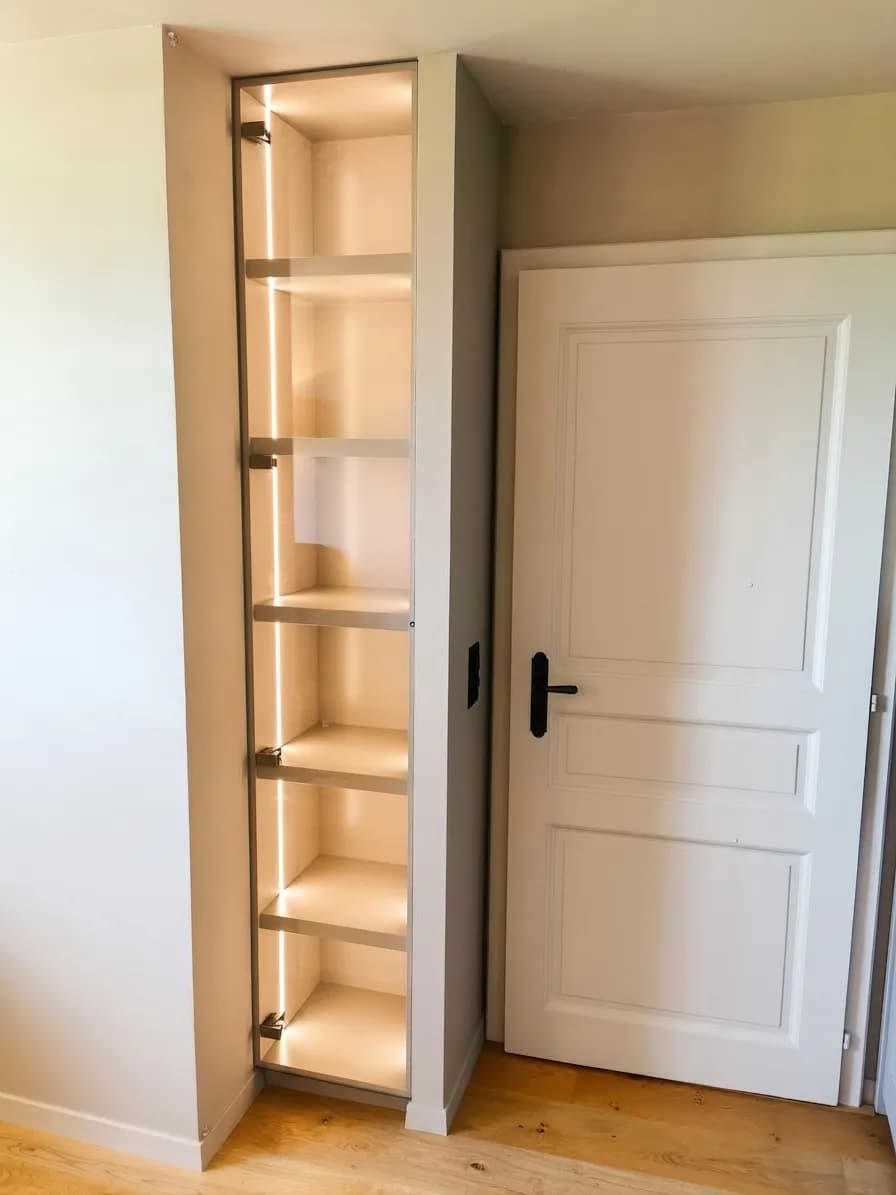
A 2700 K or 3000 K LED strip, recessed into a routed channel beneath each shelf, illuminates the books without causing glare. The channel is sized to house the aluminium profile and conceal the strip from the normal viewing angle. The power supply is centralised within an upright and exits via a single cable, coordinated with the electrician before installation.
Adjustable spotlights in the upper section
For a tall bookcase, spotlights recessed into a cornice or top rail allow light to be directed at specific areas — a collection, a display object, an object drawer. This solution requires coordination between the cabinetmaker and the electrician during the construction phase. Learn more about our fitted pieces with integrated lighting.
Bespoke bookcases for atypical spaces
It is often in "difficult" rooms that a bespoke bookcase truly comes into its own. Some recurring configurations from our order book:
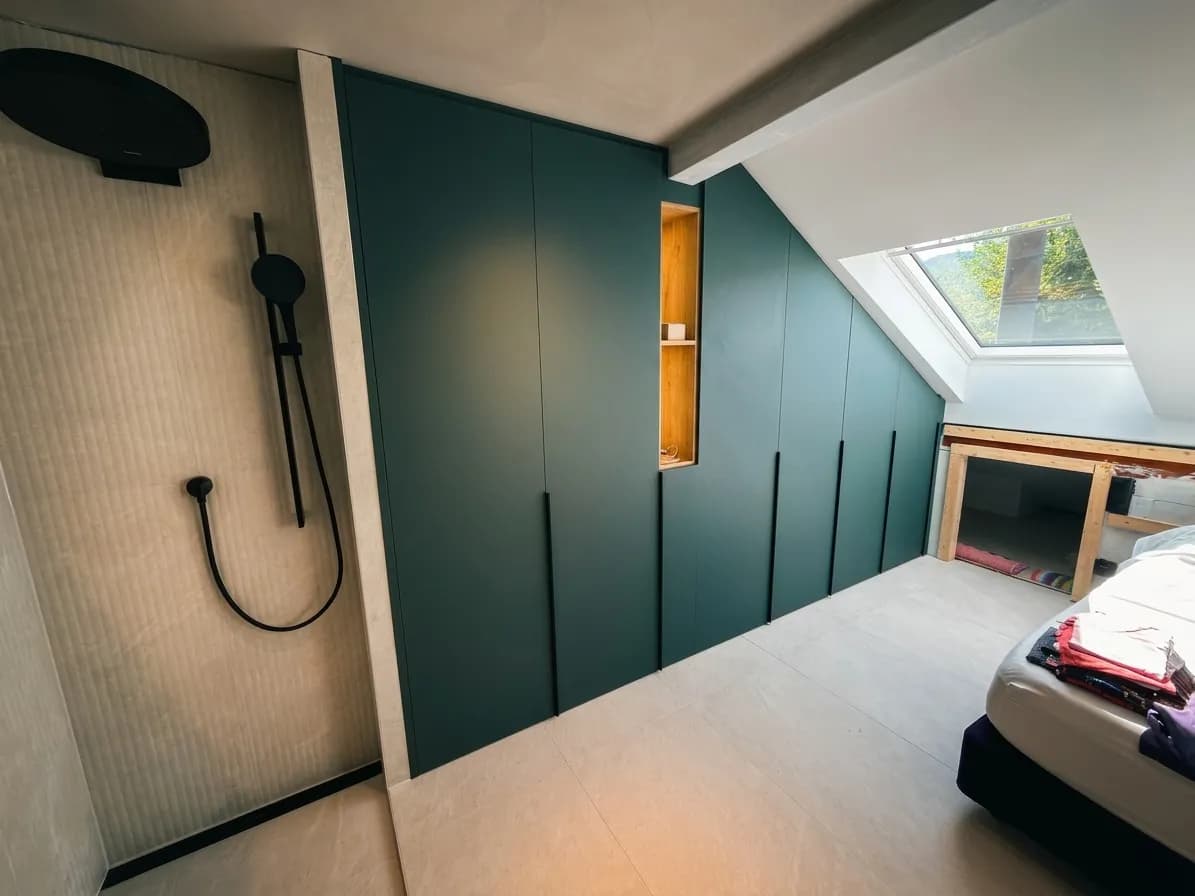
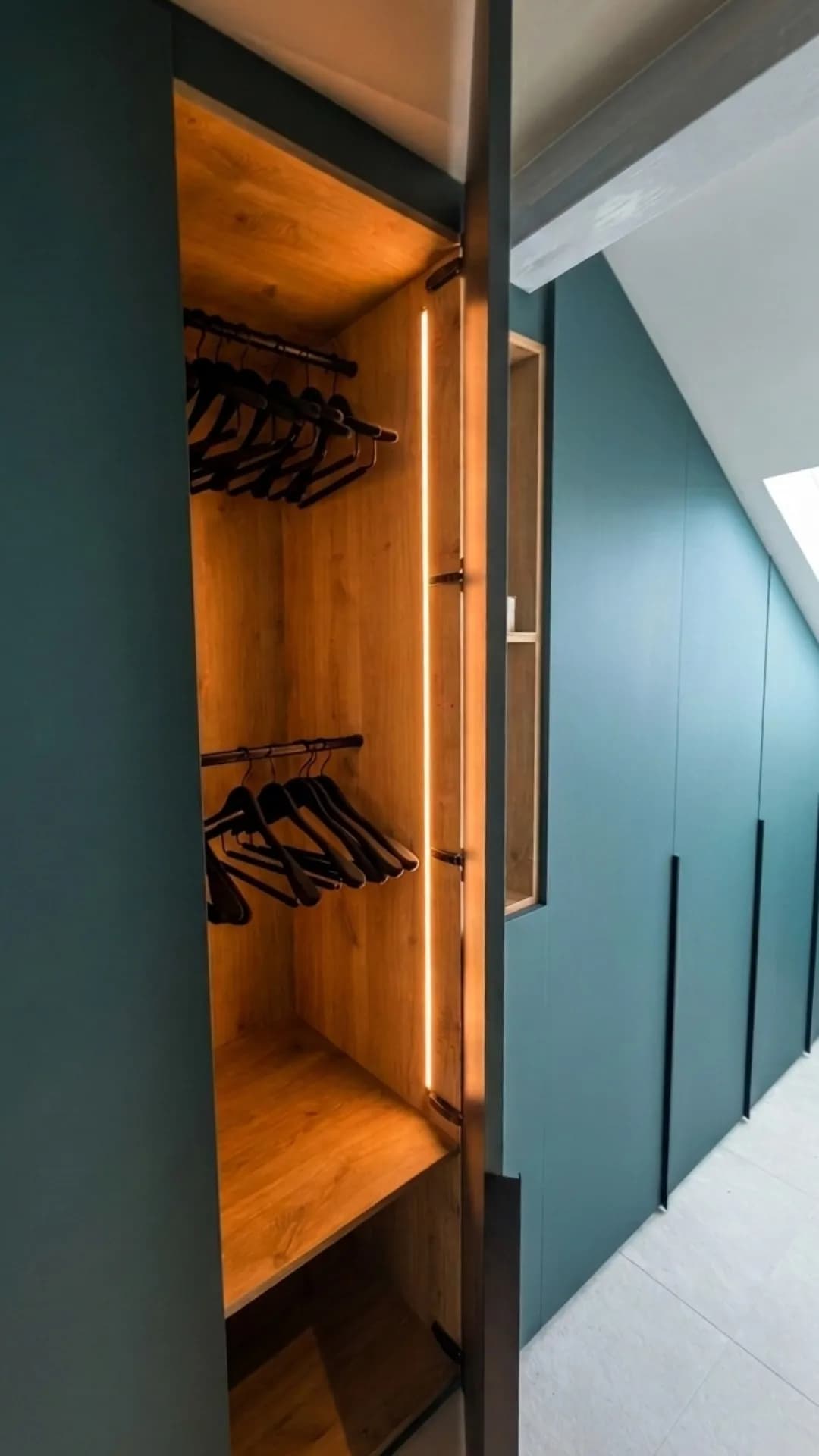
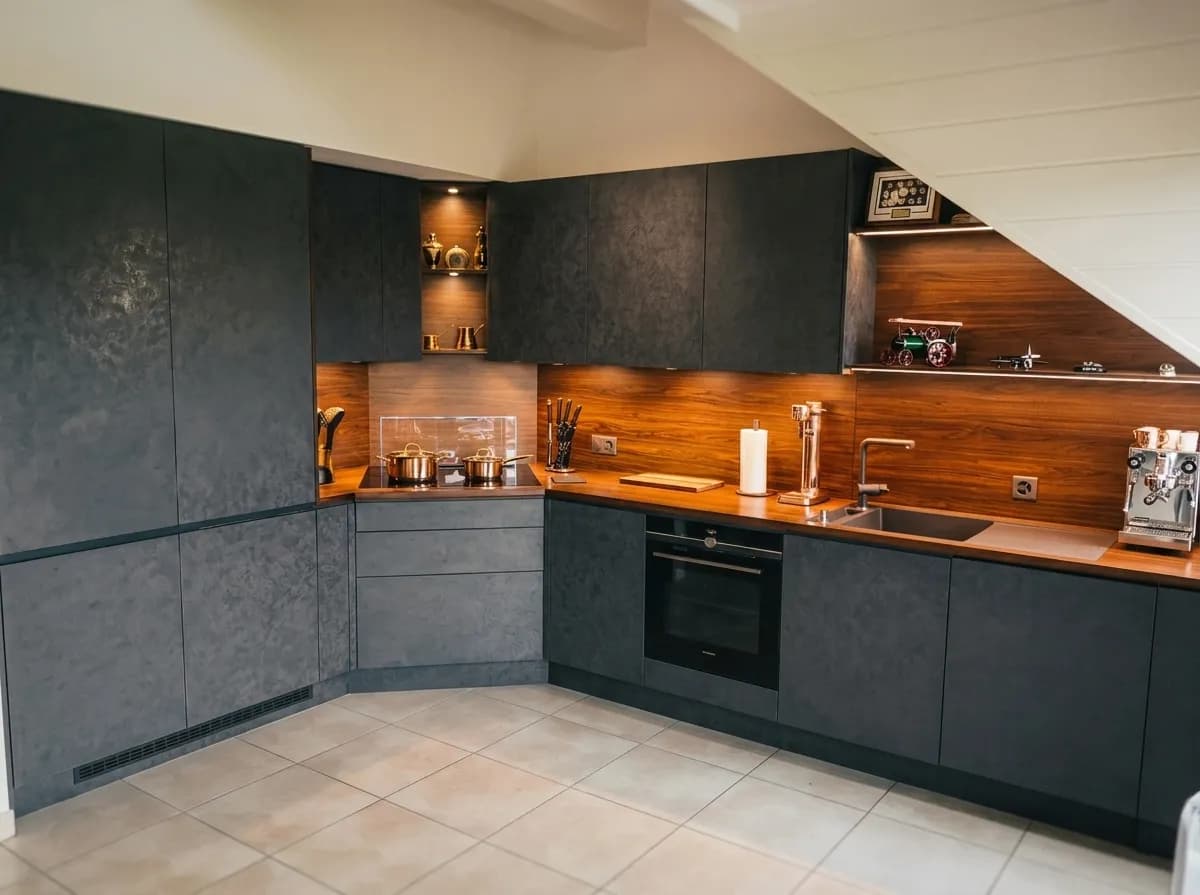
- Under a sloping ceiling: the uprights are angled to match the exact pitch of the roof slope, while the shelves remain horizontal. We work from a template taken on site to avoid any discrepancy during installation. Find budget benchmarks for sloped-ceiling fitted pieces.
- Around a doorway: the bookcase spans the opening with a bridging cabinet at the top; the uprights frame the door like architectural panelling.
- Inside an alcove: dimensions are taken to the millimetre, the back is veneered or painted in a background colour, and the side panels are fixed directly into the masonry with anchors suited to the substrate (concrete, brick, Ytong).
- Double-height bookcase: as soon as the height exceeds 280 cm, a rolling library ladder on a rail is often integrated. The rail is fixed into a solid timber rail plate, and the bookcase is anchored to the floor and ceiling to resist lateral forces.
Realistic budgets and lead times in Romandy
Price ranges depend directly on materials, dimensions, and the options chosen. Without publishing firm figures — every project is individually quoted — here are the parameters that affect cost:
- A simple melamine or lacquered MDF bookcase without doors is substantially less expensive than a piece of the same dimensions made entirely in solid oak.
- Adding glazed doors represents an additional cost related to hardware, glazing, and frame work.
- Integrated LED lighting adds routing, wiring, and coordination work; it should be counted as a fully separate service.
- A bookcase over 300 cm tall generally requires two cabinetmakers for installation, which increases the fitting cost.
On lead times: a bespoke bookcase without doors or complex lighting is generally delivered within six to ten weeks of plan approval. A bookcase with doors, integrated lighting, and architectural integration (cornice, panelling, masonry work) may require ten to twelve weeks. The schedule is shared upon signing the quote. For an overview of the steps and lead times, consult this guide on bespoke furniture projects.
Our pieces come from a workshop that both builds and installs its own work: the cabinetmakers who built your bookcase are the ones who come to fit it, which eliminates any gap in interpretation between the workshop and the site.
Questions to ask before starting the project
Before the first visit, it is useful to gather a few concrete pieces of information. These are the same questions we ask at every initial contact:
- What are the available width, height, and depth? Are there sockets, conduits, or radiators to accommodate?
- What types of books or objects will be stored — formats, approximate weight?
- Will the bookcase be open, glazed, or solid-fronted?
- What is the style of the existing interior — contemporary, classic, Scandinavian, industrial?
- Is there an electrician constraint to coordinate for the lighting?
- What is the desired installation timeline?
These six points allow us to put together a serious initial estimate and, if the project moves forward, to schedule the measurement visit. Browse our completed work to see concrete examples of bookcases and fitted pieces.
Key takeaways
A bespoke bookcase comes down to three decisions: the structural material (solid wood, veneer, or lacquered), the thicknesses suited to the actual spans, and the complementary options (doors, lighting, ladder rail). The budget varies with these choices, but the six-to-twelve-week lead time remains constant for the vast majority of projects in Romandy. The more atypical the space — alcove, sloping ceiling, double height — the more bespoke is the only coherent answer.
Talk about your project
At TOMÉ Ébénisterie, every bespoke bookcase begins with a conversation. Describe your room in a few lines — dimensions, style, use, constraints — and we will reply within 48 hours with an initial direction or a proposal for a site visit. The measurement visit then allows us to take exact dimensions, choose the timber species, and confirm the 3D plans before any cutting begins. No surprises between the quote and the installation: the cabinetmakers who build your bookcase are the ones who fit it. Contact us via the contact form.