Summary: A bespoke solid-wood table is made to the exact dimensions of your dining room, in the timber species and finish of your choice, and assembled using repairable methods. Its cost is often comparable to the premium ranges of commercial furniture retailers, at genuinely equivalent quality. The gap widens most over time: a solid-wood top can be sanded and re-oiled indefinitely, whereas a reconstituted-panel top has only one life.
In a Lausanne flat with walls that were anything but straight, the flat-pack table from the shop didn't reach the wall by the window. Twenty centimetres of gap, a chair that barely squeezed through — and six people to seat for the holidays. It is often from a detail as mundane as this that the question of a bespoke solid-wood table genuinely arises. Not as a luxury, but as the answer to a precise constraint.
This article weighs both options honestly: what a shop-bought table offers, what it cannot offer, and what workshop fabrication changes concretely — in terms of dimensions, species, finish and service life.
What "solid wood" really means in a table
The "solid wood" label covers very different realities depending on the manufacturer. In a commercial outlet, it can refer to a plantation-pine glulam top — solid, certainly, but made from young, wide-grained, low-density timber that is prone to scratches. In our workshop, solid wood means slow-grown European oak, American walnut, ash or maple — species whose density and stability are well known and documented.
The difference shows in daily use. A 40 mm-thick European oak top absorbs heat from a dish placed on it differently, scratches less easily, and reacts more slowly to changes in humidity — an important point in the canton of Vaud, where heated interiors can drop below 35 % relative humidity in winter, causing the wood to move.
Dimensional stability in practice
Solid wood moves. That is its nature, and a cabinetmaker accounts for this from the outset: grain direction, board assembly, plank width, clearances built into the joints. An industrial glulam top is often glued with alternating grain directions to limit this movement, but without accounting for the specific humidity of the room where it will sit. In our workshop, the timber dries for several weeks before any work begins, and the final dimensions incorporate the predictable behaviour of the chosen species in your space.
Dimensions, number of guests and circulation: designing before cutting
A shop-bought table comes in 180, 200 or 220 cm. Your dining room, however, is whatever size it is — and circulation around the table requires roughly 90 cm on each side so that pushed-back chairs don't block the way. That simple calculation often rules out standard formats.
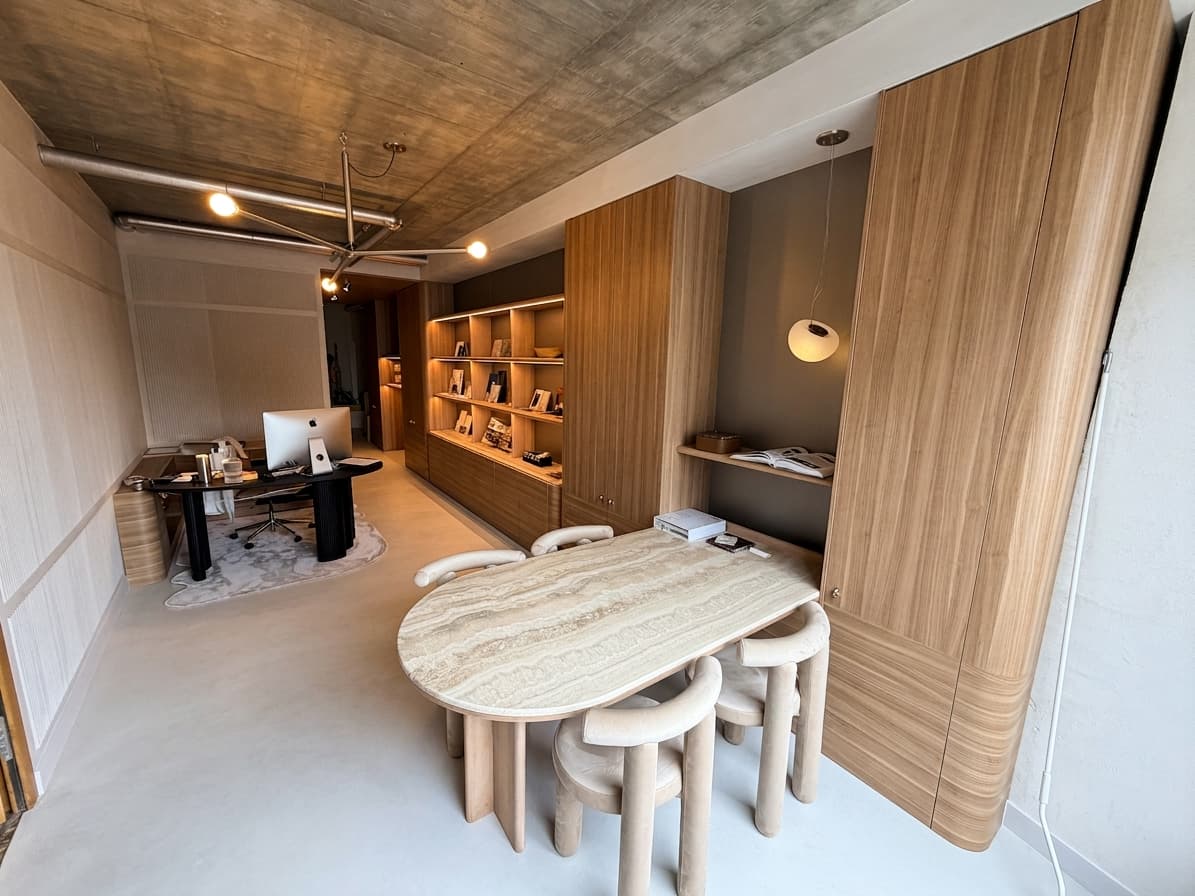
For a bespoke table, we start from the actual room: available length, radiator and socket positions, circulation routes, usual number of guests and maximum to cater for. A table of 240 × 95 cm can seat ten people comfortably in a space of 420 × 340 cm, whereas a 220 cm shop-bought table creates an uncomfortably narrow aisle on the wall side.
Height — often overlooked
The standard dining-table height is around 75 cm, but that figure is not universal. With high-seated chairs, or for a family whose members are over 185 cm tall, 76 to 78 cm brings noticeable comfort. This is an invisible adjustment in a shop, and a trivial one in the workshop.
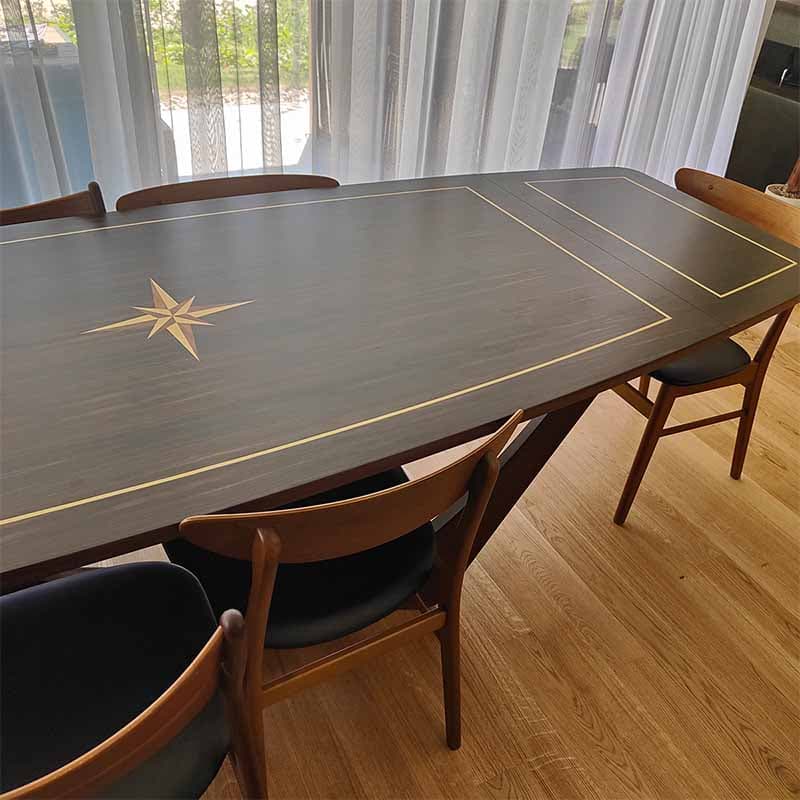
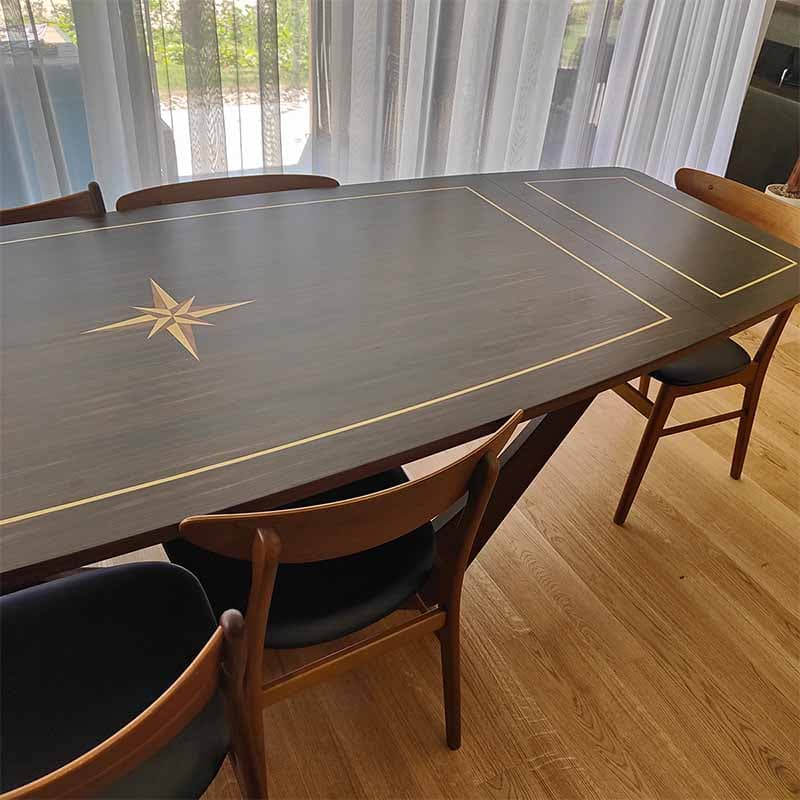
 real project photo
Available species and what sets each one apart
The choice of species determines the colour, hardness, ageing characteristics and price of the top. Here are the species we work with regularly for tables:
- European oak: the reference timber, Janka hardness of around 5,900 N, pronounced grain, ages towards a golden honey tone. Robust for intensive daily use.
- American walnut: darker, visually lighter, often with a wavy grain. More susceptible to scratches than oak, but highly prized for its character. We covered this species in depth in our article on American walnut.
- Ash: pale, straight-grained, contemporary in appearance. European ash is now scarcer due to ash dieback; we mainly work with American ash or olive ash for projects where lightness and visual clarity are sought.
- Maple: very pale, very hard, with almost no visible grain. Favoured for Nordic or minimalist interiors.
- Beech: economical, even-textured, ideal for side tables or children's tables.
- Cherry: a pinkish tone that deepens with light, fine grain. Rarer, reserved for projects where warmth of character takes priority.
The price of the top varies significantly by species: European oak and beech are the most accessible, American walnut and cherry the most costly. The supplier we work with, BWF – Bois et Forêt, allows us to select planks for quality on each project individually.
Finishes: oil, varnish, lacquer — and what that means for maintenance
The finish determines the appearance, resistance and how the table is maintained over the years. Three main families:
Oil or wax
An oiled finish penetrates the wood without forming a surface film. The top retains its matt, natural feel. Minor scratches blend into the material rather than marking a film. The downside: liquid spills must be wiped up promptly, and a refresh with the appropriate oil is useful once or twice a year depending on use. This is the finish we recommend for oak or walnut tables in family settings.
Varnish or matt lacquer
Varnish forms a protective film on the surface. It offers better resistance to liquids and moderate heat. A matt-lacquered top wipes clean with a damp cloth. The trade-off: when the film is scratched deeply, the repair is more visible than with an oiled finish. Our lacquer finishes are applied in a spray booth in a controlled environment, giving a consistency that is impossible to achieve by brush.
Mixed finish
Some clients opt for an oiled underside of the top — for the feel — and a toughened glass sheet placed on top for everyday use, removed for dinner parties. A pragmatic approach that protects without compromising the look.
Repairability: the real difference over twenty years
A commercial table with a veneered glulam top will scratch, delaminate and swell if moisture gets in. Repair is generally impossible: once a veneer has lifted or been scratched through to the panel, it cannot be re-laid cleanly. The table ends up as waste.
A solid-wood table can be sanded back indefinitely, within the limits of the top's thickness. A 40 mm top can be sanded several times over its lifetime. An oiled finish can be renewed at home. Damaged lacquer can be sanded back and re-lacquered in the workshop. We do this regularly for antique pieces we did not make ourselves.
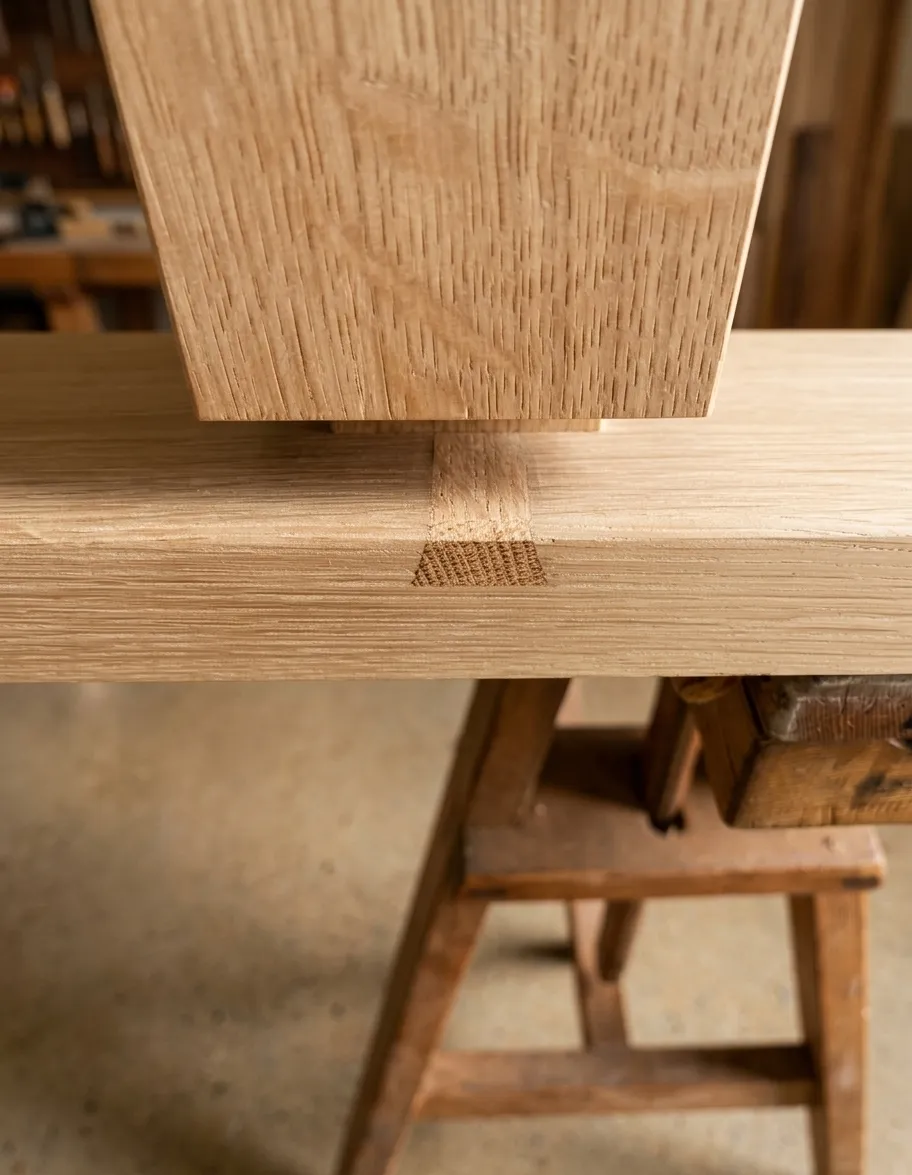
This is why we speak of pieces that are repairable component by component: the design ensures that each element can be treated separately, without complete disassembly. For more on the logic of durability and budgeting, our article on the budget and lead times for a bespoke furniture project provides concrete reference points.
Budget: at equivalent quality, where do the two options stand?
Comparing a shop-bought table with a bespoke one requires comparing at genuinely equivalent quality — which is rarely done. A quality solid-oak commercial table, from the upper ranges of European furniture publishers, easily fetches between CHF 2,500 and CHF 5,000 for a 200 × 95 cm format. A bespoke European oak table, the same format, oiled finish and a simple steel or solid-wood base, will sit in a similar bracket or slightly above — with the added advantages of exact dimensions, species selected plank by plank, and a finish applied in a spray booth.
The gap widens if you choose a rare species, an elaborate base, a very wide top or integrated leaves. But comparing it with mass-market veneered-panel furniture makes no sense: the two objects do not have the same service life.
We do not publish fixed prices, because every table is different. A first conversation is all that is needed for an honest estimate before any commitment. Lead times for a single table are in the order of 6 to 10 weeks: two to three weeks for design and timber selection, four to six weeks for fabrication.
The process, from first meeting to installation
For a table, a site visit is not always essential if you have clear plans and photographs. Here is how the project moves forward in practice:
- First contact: you describe your project in a few lines — desired dimensions, number of guests, preferred species or style reference. We respond within 48 hours with a first estimate or follow-up questions.
- Plan approval: we produce a detailed drawing and, depending on complexity, a 3D image. No cutting takes place before your written approval.
- Timber selection: for solid tops, planks are selected for quality at our supplier. Grain direction, figure and colour are chosen to suit your space.
- Workshop fabrication: at Gingins, in our workshop on the Chemin des Cheseaux. The cabinetmakers who build the table are the ones who will deliver and install it.
- Delivery and installation: for a table, installation is straightforward — half a day as a rule. Final levelling and maintenance advice are given on site.
For a full picture of how our workshop operates and of our completed projects, you can browse our projects or read our thoughts on 2025 trends in interior design and cabinetmaking.
Key takeaways
A bespoke solid-wood table is not automatically more expensive than a shop-bought table at comparable quality — it is above all different in its logic: dimensioned for your space, made in a species chosen plank by plank, finished in a spray booth, and repairable over several decades. The points to remember: allow 6 to 10 weeks between order and delivery, arrange an initial no-commitment conversation to frame the budget, and look honestly at what "solid wood" actually means in the commercial range you are comparing against.
Talk to us about your project
Our workshop operates without subcontracting: the cabinetmakers who build your table are the ones who deliver it. If you have a size constraint, a species in mind, or simply a room to furnish and no idea where to start, describe your project in a few lines via our contact form. We respond within 48 hours with a first estimate or a proposal to meet. Telephone: +41 79 367 26 99, Monday to Friday, 08:00 to 18:00.